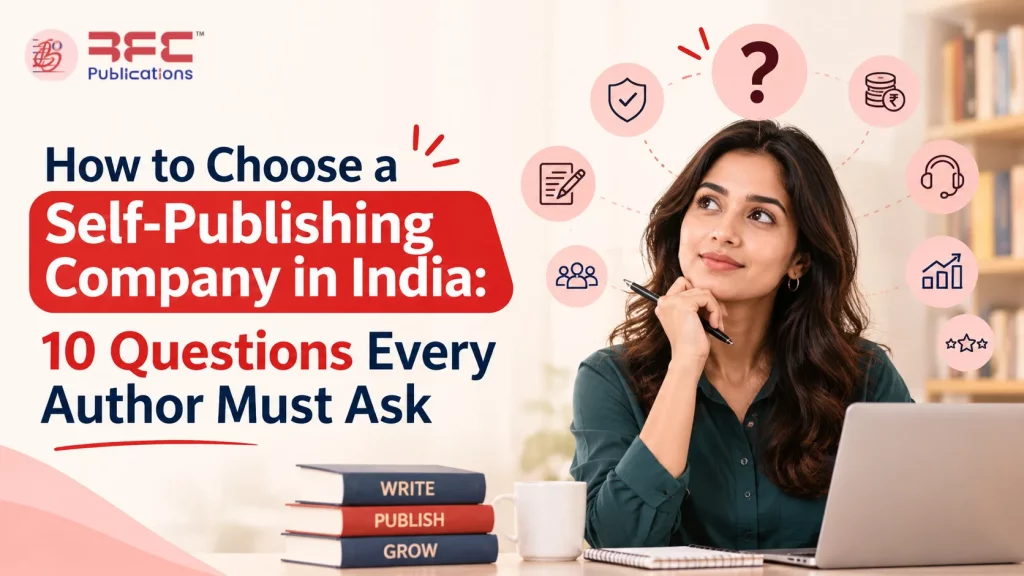
You have finished your manuscript, and now comes the decision that shapes everything after it: which self-publishing company will you trust with your book? In India there are plenty of options, and most look the same online. They all offer “100% royalty,” “worldwide distribution” and “complete publishing support.” The real differences sit in the contract, the fee structure and how directly a company answers your questions.
Use the ten questions below as a filter before you pay or sign anything. A trustworthy self-publishing company will answer them clearly and put the answers in writing. If you are still weighing your options, our guide to a book publisher in India explains the main publishing routes.
1. Who owns my copyright?
Under Indian law, you own your book the moment you write it. A publisher only needs a licence to print and sell it, not ownership. Look for wording that confirms you keep full rights. Any clause about assigning, transferring or sharing your copyright is a reason to walk away. You can read more on the official Copyright Office of India website.
2. How exactly are royalties calculated?
“100% royalty” means little without the formula behind it. Ask for a worked example in rupees using your page count and MRP, showing printing cost, platform commission and what you earn per copy. If you can’t see the maths before paying, you can’t judge the deal.
3. Where will my book actually be sold?
“Worldwide distribution” is a phrase, not a plan. Ask for a named list of platforms, such as Amazon, Flipkart, Google Play and Kindle, plus the international network used. Also confirm whether eBook distribution is included or sold as an extra. Our eBook publisher in India page shows how digital distribution should work.
4. Can I read the contract before paying?
You should see the full agreement before any money changes hands, and you should be free to show it to a lawyer or a trusted friend. A company that sends the contract only after payment is telling you something important.
5. What is included, and what costs extra?
Low package prices often grow through add-ons: ISBN, eBook conversion, extra editing rounds, author copies, cover revisions. Ask for an itemised written list of inclusions and exclusions so your final bill matches the advertised price. Not sure what an ISBN is or whether you need to pay for one? Read what is an ISBN and how to get it for your book.
6. What is the realistic timeline?
Ask for milestones: editing, cover design, formatting, proof approval and going live. A promise of “30 days” with no breakdown is a sales line. Also ask whether delivery dates are written into the agreement. Check how the company handles book editorial services, since editing is where delays usually begin.
7. Can I speak to recent authors?
Website testimonials are selected by the company. Ask to speak to two or three authors who published in the last few months, and ask them about communication, delays and royalty payments. A confident self-publishing company will arrange this readily.
8. Who controls my book’s price?
Your royalty depends on the MRP, so pricing decisions directly affect your income. You should set the price, with advice from the company. Be careful of clauses that allow discounts or price changes at the publisher’s discretion.
9. Can I leave, and take my book with me?
Check the termination clause. You should be able to exit once services are delivered, with your files and rights intact. Watch for long lock-in periods, exit penalties, or rights granted for the entire copyright term with no way to get them back.
10. How and when will I be paid, and can I verify sales?
Late or unclear royalty reporting is one of the most common author complaints. Ask for a written payment schedule, a platform-wise sales breakdown and a way to cross-check the numbers independently. If your book is sold through print on demand book publishing, sales data should be easy to verify.
Not sure which questions apply to your book? Talk to our publishing experts for free →
Three red flags that should end the conversation
Beyond the ten questions, these three warning signs justify walking away immediately:
- A guaranteed bestseller. No company can promise this. It is a classic tactic to sell you expensive marketing add-ons.
- Payment demanded before you see the contract. Legitimate companies are comfortable with you reading the terms first.
- “Sign today or lose the offer.” Artificial urgency exists to stop you from asking questions, comparing options and thinking clearly.
Also read our list of self-publishing mistakes to avoid before you commit to any company.
How to use this checklist
Shortlist three companies and email each the same ten questions. Written replies give you a record, and they make comparison easy. Pay attention to more than the answers. Notice how quickly and openly each team responds, whether they avoid specifics, and whether they push you toward payment instead of information.
A good self-publishing company treats these questions as normal and welcomes them. Choosing one is a long-term decision about your work, your rights and your earnings, so take the time to get it right. Once your book is live, a strong plan matters too, so explore our book marketing services.
Ready to Publish with a Self-Publishing Company You Can Trust?
At BFC Publications, we answer every question above openly, including contract terms, pricing, distribution and royalty process, before you commit.
FAQs
What is a self-publishing company?
A self-publishing company offers paid services such as editing, cover design, formatting, ISBN, printing and distribution, while the author keeps ownership of the book and its rights.
How do I choose the best self-publishing company in India?
Compare copyright terms, the royalty formula, named distribution platforms, hidden costs, timelines and contract exit terms. Ask every company the same questions in writing.
Do I keep my copyright when I self-publish?
You should. A genuine self-publishing company needs only a limited licence to publish and distribute your book, never ownership of it.
Is a self-publishing company safe to trust with my manuscript?
It can be, if it shares the contract before payment, names its distribution channels, explains royalties in numbers, and connects you with recent authors.