Mood is how a writer shapes the emotional experience of reading a story — using word choice, imagery, setting, and pacing — so the reader feels something and stays engaged. It’s not what happens in a scene; it’s how the scene feels to read.
A skilled writer can describe the exact same forest as peaceful or terrifying using nothing but craft choices. That’s the power of mood — and it’s one of the most important (and most underused) tools in an author’s toolkit.
In this guide, you’ll learn what mood actually means, how it differs from tone and atmosphere, and 15 proven techniques — each with a literary example — that you can apply to your own manuscript today.
What Is Mood in Literature?
Mood in literature is the emotional atmosphere a piece of writing creates in the reader — the feeling of tension, warmth, dread, or joy that lingers as you read. Mood is built through diction, imagery, setting, and sentence rhythm working together, and a skilled author can shift it deliberately as the story progresses to control how the reader feels at every stage.
Mood vs. Tone vs. Atmosphere: What’s the Difference?
These three terms get confused constantly, so here’s the clearest way to separate them:
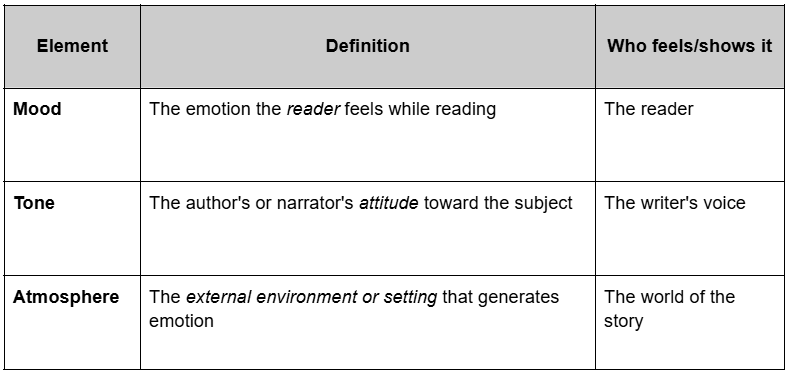
Think of it like a film: mood is how you feel watching it, tone is the director’s stylistic choices, and atmosphere is the lighting and scenery that make those choices land.
15 Techniques for Creating Mood in Your Writing
Each mood below includes a literary example and the specific craft techniques you can borrow for your own writing.
1. Melancholy
Technique: Use soft, reflective diction and imagery tied to memory or loss — slower sentence rhythm, muted color words, repetition of small details that signal longing.
Example: The Fault in Our Stars and Me Before You build melancholy through characters reflecting on time they can’t get back.
2. Suspense
Technique: Shorten your sentences as tension rises. Withhold information the reader wants. End scenes or chapters on unresolved questions.
Example: Closet of Lies keeps readers turning pages by constantly delaying answers.
3. Joyful
Technique: Use bright, energetic word choice and quicker pacing. Let dialogue carry warmth through short, exclamatory exchanges.
Example: Jane and Mr. Rochester’s reunion in Jane Eyre lands as pure joy because the preceding chapters were so restrained.
4. Foreboding
Technique: Plant small, unresolved details early — a strange remark, an odd silence — that only make sense later. Use weather and darkness as warning signs.
Example: Macbeth is soaked in foreboding from the witches’ opening prophecy onward.
5. Nostalgic
Technique: Blend past and present tense sensations — a smell, a song, a place — so memory intrudes on the current scene.
Example: Me Before You uses Will Traynor’s past to make his present feel heavier.
6. Romantic
Technique: Slow the pacing during intimate moments. Focus on small sensory details — a hand, a glance — rather than grand gestures.
Example: After by Anna Todd builds romantic mood through prolonged emotional tension between its leads.
7. Tragic
Technique: Foreshadow loss early, then let the narrative delay it — the gap between what the reader expects and what happens builds tragic weight.
Example: A Little Life by Hanya Yanagihara sustains tragic mood across an entire novel through accumulated small losses.
8. Hopeful
Technique: Contrast a bleak setting with a small, concrete sign of possibility — light imagery, a kind gesture, a door left open.
Example: A Thousand Splendid Suns lets readers feel hope for Mariam and Laila even inside a brutal setting.
9. Dark & Gloomy
Technique: Use isolation and silence as tools — empty rooms, absent characters, muted color palettes.
Example: The narrator’s isolation after Nastenka leaves defines the gloom in White Nights.
10. Whimsical
Technique: Break ordinary logic gently — talking objects, exaggerated characters, playful sentence structure with unexpected turns.
Example: Alice’s Adventures in Wonderland turns the everyday into the delightful through dreamlike world-building.
11. Mysterious
Technique: Give readers partial information deliberately. Let characters notice things they can’t explain.
Example: The Sherlock Holmes stories thrive on unanswered questions dropped early and solved late.
12. Angry
Technique: Use sharp, clipped dialogue and physical imagery — clenched fists, raised voices — to externalize internal conflict.
Example: Heathcliff’s rage in Wuthering Heights is conveyed through both action and violent imagery.
13. Peaceful
Technique: Slow the sentence rhythm. Use soft, natural imagery and minimal conflict in the scene itself.
Example: Walden creates stillness through quiet observation of nature.
14. Anxious
Technique: Use uncertainty and repetition — a character re-checking something, contradictory information — to mirror the reader’s unease.
Example: The constant surveillance in 1984 keeps readers in a state of low-grade dread.
15. Eerie
Technique: Rely on what’s not said — silence, absence, things slightly “off” rather than explicit horror.
Example: The Haunting of Hill House is unsettling because of what it implies, not what it shows.
Turning Mood Into a Stronger Manuscript
Understanding mood is one thing — executing it consistently across an entire novel is another. This is exactly the kind of craft issue a professional editor catches: scenes where the intended mood doesn’t land, pacing that undercuts tension, or word choices that pull the reader out of the atmosphere you’re building.
If you’re working on a manuscript and want a second pair of eyes on tone, pacing, and mood consistency, BFC Publications’ editorial services can help you sharpen it before it goes to readers.
And once your manuscript is ready, our editorial services, marketing services and distribution services can help it find the readers who’ll feel every mood you worked so hard to create.
Related reading: Top 10 Ravinder Singh Books
Frequently Asked Questions
What is mood in literature?
Mood is the emotional atmosphere a piece of writing creates in the reader, shaped through word choice, imagery, setting, and pacing.
What’s the difference between mood and tone?
Mood is what the reader feels. Tone is the author’s or narrator’s attitude toward the subject, usually shown through word choice and style.
Can mood change within a single story?
Yes. Skilled authors shift mood deliberately across a story — for example, opening peaceful, building suspense through the middle, and resolving hopeful — to control the reader’s emotional journey scene by scene.
How many types of mood are there in literature?
There’s no fixed number — mood can be any emotion a piece of writing evokes. The 15 above (melancholy, suspense, joyful, foreboding, nostalgic, romantic, tragic, hopeful, dark & gloomy, whimsical, mysterious, angry, peaceful, anxious, eerie) are among the most common in fiction.