Quick answer:
The most effective book marketing strategies for authors are: optimizing your Amazon Author Page, building an author brand on social media, running a pre-launch email list, getting reviews from ARC readers, collaborating with bookstores and literary festivals, producing ebook/audiobook formats, and using giveaways to drive word-of-mouth. Most of these cost little to nothing beyond time.
Book marketing is the set of strategies authors use to build audience awareness and turn that awareness into sales — both online (social media, email, Amazon, Bookstagram) and offline (bookstores, literature festivals, book clubs). A great book with no marketing plan usually sells fewer than 100 copies in its first year; a mediocre book with a strong plan regularly outsells it.
Here’s the truth most new authors don’t hear until it’s too late: writing the book is half the job. Getting it into readers’ hands is the other half — and that half runs on strategy, not luck.
This guide breaks down 7 marketing strategies you can start using today, whether you’re launching your first book or trying to revive an older one that’s stalled.
Why Does Book Marketing Matter So Much?
India’s book market was valued at roughly USD 5,132.83 million in 2025, and online is now the largest distribution channel, accounting for 44.3% of sales in 2025. That shift matters for you directly: if nearly half of all books in India are bought online, your Amazon listing, your search visibility, and your social presence are doing the job a bookstore shelf used to do. A book that isn’t actively marketed isn’t a bad book — it’s simply an undiscovered one. Imarcgroupimarcgroup
7 Book Marketing Strategies That Actually Work
1. Optimize Your Amazon Author Page
Your Amazon Author Page is often the first place a curious reader lands after seeing your book. A complete, optimized page lets you:
- Manage and respond to customer reviews
- Link all your books together so readers discover your full catalog
- Add a bio, photo, and blog feed so readers connect with you as a person, not just a book cover
- Reach readers globally without spending on ads
Do this: Fill out every section — bio, photo, social links, and an Amazon Author Central blog feed — and keep it updated with each new release.
2. Build an Author Brand Through Content and Keywords
Readers don’t just buy books — they follow authors. Start a blog or regularly post content (videos, reels, short essays) about your writing process, your book’s themes, and insights for other writers. This does two things: it builds a personal brand, and it puts you in front of readers who are actively searching.
That search part matters more than most authors realize. When someone searches for a topic your book covers, they’re typing specific words and phrases — keywords. Weaving these naturally into your book description, blog posts, and social captions helps potential readers find you organically, without paid promotion. For example, if you’ve written a thriller set in Mumbai, terms like “Mumbai crime thriller books” or “Indian mystery novels 2026” should show up in your book blurb, blog tags, and social bios.
3. Run a Pre-Launch Email List and ARC Campaign
Before your book is even live, start collecting emails from interested readers — through a simple landing page, your social bio, or a “notify me” form. Send your list:
- Sneak peeks and cover reveals
- ARC (Advance Reader Copy) offers in exchange for honest reviews before launch day
- Launch-week promotional pricing for loyal subscribers
Authors who treat launch as a multi-week campaign — weeks of pre-launch buildup, a concentrated launch week, and a month of follow-through — consistently outsell those who treat launch day as a single announcement.
4. Collaborate with Bookstores, Literary Festivals, and Media
Get in front of readers in person and through the press. Reach out to media contacts for interviews and Q&As, apply to speak at literature festivals, and approach local bookstores about hosting a launch event. These collaborations build the kind of third-party credibility that a social media post alone can’t.
5. Publish Ebook and Audiobook Editions
Not every reader wants a paperback. Releasing your book as an ebook and audiobook opens it up to readers who prefer digital formats — often a larger and faster-growing segment than print, especially among younger and urban readers. It’s also one of the lowest-cost ways to expand your reach, since there’s no additional printing or shipping cost per copy sold.
6. Run Contests, Giveaways, and Limited Offers
Giveaways and contests create urgency and word-of-mouth. Offer a signed first copy, a discount code, or a bundle prize tied to sharing or reviewing your book. Contests work especially well timed around your launch week or a festival/holiday season, when readers are already primed to discover new books.
7. List Your Book Across Every Relevant Platform
Beyond Amazon, list your book on Flipkart, Goodreads, your own website/store, and any genre-specific platforms your readers use. Each additional listing is another door for a potential buyer to walk through — and Goodreads in particular doubles as a review and discovery engine that influences buying decisions.
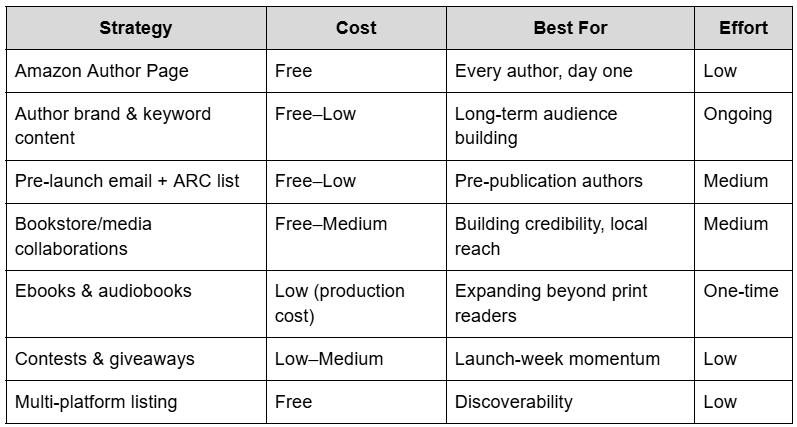
Which Book Marketing Strategy Should You Start With?

How Can BFC Publications Help You Market Your Book?
BFC Publications has supported authors through every stage of the publishing journey — from drafting to distribution across trusted marketplaces and bookstores. Our team analyzes each author’s genre, audience, and goals to build a tailored marketing plan, including:
- Instagram and Facebook ad campaigns
- Video trailer launches and YouTube bumper ads
- Amazon Author Page setup
- Twitter/X marketing
- Google Ad campaigns
Explore our marketing services →
Frequently Asked Questions
How can authors market their book for free?
Free strategies include optimizing your Amazon Author Page, posting consistent content on social media, listing your book on Goodreads, collecting reviews from readers, and reaching out to book bloggers or bookstagrammers for coverage.
What is the best platform to promote a book in India?
Amazon and Flipkart drive the largest share of online book sales in India, but Instagram (Bookstagram) and WhatsApp groups are especially influential for word-of-mouth discovery among Indian readers.
How much does book marketing typically cost?
It ranges from free (organic social media, email lists, Goodreads listings) to a few thousand rupees for targeted ad campaigns or professional marketing packages. Many authors start free and reinvest early sales into paid promotion.
When should authors start marketing their book?
Ideally 6–8 weeks before launch, with a pre-launch email list, ARC reviews, and cover reveal — then continuing marketing for at least a month after release, since most sales momentum builds over weeks, not a single launch day.
Do ebooks or audiobooks sell better than print books?
It depends on genre and audience, but digital formats let you reach readers who don’t buy print, at a lower incremental cost — making them a useful addition to, not a replacement for, a print release.
The Bottom Line
Marketing has the power to make or break a book’s success, no matter how strong the writing is. The seven strategies above — from Amazon optimization to giveaways — work best in combination, applied consistently over weeks and months rather than as a single launch-day push.
If you’ve made it this far, you have a working checklist. Now it’s time to put it into action.
Read next: How to Sell Books on Amazon: A Guide for Authors and Publishers