Quick Answer:
A synopsis is a brief, structured summary of a longer work — a novel, research paper, screenplay, or project — that outlines its key points, plot, or findings, including the ending. It’s different from a blurb (which hides the ending to create curiosity) and typically runs 500–800 words for a novel, though academic and project synopses can run longer.
What is Synopsis?
A synopsis is a brief, structured summary of a longer work a novel, research paper, screenplay, or project that lays out its key points, plot, or findings in a clear and condensed form. Unlike a back-cover blurb, a synopsis doesn’t tease the reader it tells them exactly what happens, including the ending.
If you’re an author preparing to submit a manuscript to a literary agent or publisher, a student writing a thesis proposal, or a screenwriter pitching a script, you’ve probably been asked for a synopsis at some point. This guide covers what it actually is, the different types, how long it should be, and a step-by-step process for writing one with a worked example at the end.
Synopsis vs. Summary vs. Blurb: What’s the Difference?
These three terms get confused constantly, so here’s a direct comparison:
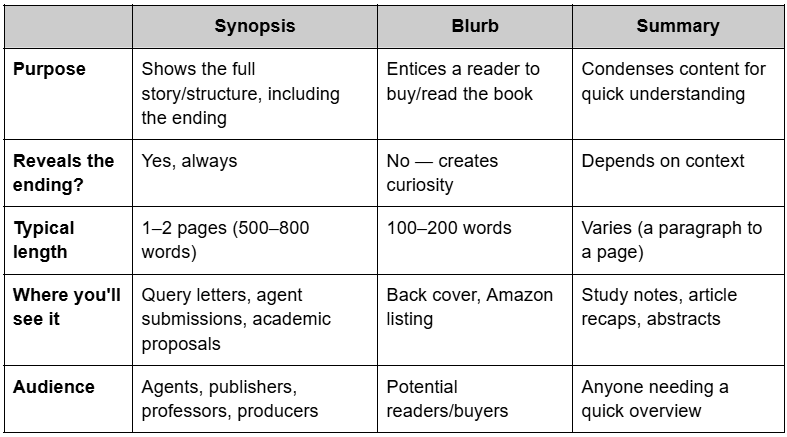
The most common confusion is with the ending: a blurb hooks a reader without giving anything away, while a synopsis exists specifically to show an agent or publisher how the story resolves — they need to know the ending works before they invest in the book.
Importance of a Synopsis
A synopsis matters for a few concrete reasons:
Time Efficiency. A synopsis lets an agent, publisher, or professor evaluate the core content quickly, without reading the entire work, so they can decide whether it’s worth pursuing further.
Guidance for Writing. Writing a synopsis before drafting the full work gives you a roadmap — it forces you to nail down plot structure or argument flow before you’re deep into the writing itself.
A Marketing and Submission Tool. In publishing, a synopsis is often a required part of a submission package alongside a query letter and sample chapters. A weak synopsis can get a manuscript rejected before an agent even reads the opening pages.
Types of Synopsis
The right length, tone, and structure of a synopsis depends heavily on which type you’re writing.
Literary Synopsis (Book/Novel Synopsis)
Summarizes the main characters, plot arc, and key turning points of a novel or story — including the ending. This is what literary agents and publishers ask for in a submission package, and it’s the version most first-time authors need help with.
Academic Synopsis
Used for PhD theses, dissertations, and research papers. It outlines the research question, methodology, findings, and conclusions, giving reviewers a fast way to assess the scope and contribution of the work.
Project Synopsis
Used for business proposals and research/mission plans. It highlights objectives, methodology, scope, and expected outcomes — essentially a condensed pitch of the entire project.
Film and Screenplay Synopsis
Outlines the storyline, key scenes, and characters of a screenplay, used in pitch meetings and production submissions. Like a literary synopsis, it typically reveals the ending, since producers need to evaluate the full arc.
How Long Should a Synopsis Be?
There’s no single universal length — it depends on the type and what’s being requested:
- Literary/novel synopsis: typically 500–800 words (1–2 pages), though some agents ask for a one-page version specifically
- Academic synopsis: often longer, running 2–5 pages depending on the institution’s requirements
- Film/screenplay synopsis: usually kept to a single page, sometimes just a few paragraphs for a logline-adjacent pitch
- Project synopsis: varies by organization, often 1–3 pages
Always check the specific submission guidelines first — an agent asking for “a one-page synopsis” means exactly that, and going over is one of the more common reasons submissions get rejected outright.

How to Write a Perfect Synopsis: 7 Steps
1. Understand the Purpose
Before writing anything, know who’s reading it and why. A synopsis for a literary agent needs a different emphasis (voice, marketability, resolution) than one for a professor (rigor, methodology, findings).
2. Start With a Hook
Open with a line that captures the central conflict or premise immediately — the same instinct you’d use for a great opening paragraph. Agents read hundreds of synopses; the first two sentences decide whether they keep reading.
3. Summarize the Main Plot or Argument
Identify the essential throughline — the central conflict and its major turning points for fiction, or the core argument, method, and findings for academic or project work. Cut every subplot or secondary detail that doesn’t affect the main arc.
4. Keep It Concise
Stick to what matters. Avoid getting pulled into minor characters, side plots, or tangential findings — a synopsis rewards ruthless editing more than any other kind of writing.
5. Maintain a Logical Flow
Present events or arguments in the order they actually happen — chronological for most fiction, and following your paper’s actual structure for academic work. Don’t jump around; a confusing synopsis reads as a red flag about the underlying work.
6. Reveal the Ending
Unlike a blurb, a synopsis must show how the story or project resolves. Agents and publishers are evaluating whether the ending works — leaving it out is one of the most common synopsis mistakes new authors make.
7. Revise and Edit
Read it aloud, cut anything that doesn’t earn its place, and get a second opinion from a mentor, editor, or peer. A synopsis with grammatical errors or a confusing structure undermines confidence in the manuscript itself, even if the manuscript is strong.
Example: A Short Synopsis
Here’s what a compact literary synopsis looks like in practice (roughly 100 words, condensed from a full-length version):
After losing her family’s farm in a drought, Mara takes a job mapping abandoned mining towns for a state survey. In the third town, she finds records suggesting her grandfather didn’t disappear — he was erased from local history after exposing a mining company’s cover-up. As Mara digs deeper, she’s followed, threatened, and eventually forced to choose between publishing the evidence and protecting the town that depends on the same company for jobs. She publishes anyway. The company collapses within a year, and Mara stays to help rebuild the town from what’s left.
Notice this version does what a blurb never would: it names the ending outright, because that’s precisely what a synopsis is for.
Conclusion
A synopsis isn’t just a shorter version of your book or project — it’s a specific tool with its own rules, chief among them: don’t hide the ending. Whether you’re preparing a submission package for a literary agent, writing an academic proposal, or pitching a screenplay, the same core principles apply — understand your audience, keep it tight, follow a logical structure, and show the complete arc.
If you’re preparing your manuscript for submission or publication, BFC Publications’ editorial services can help you tighten your synopsis alongside the manuscript itself, so both are ready when you approach agents or start the self-publishing process.
FAQs
What is the difference between a synopsis and a summary?
A summary is a general condensation of any content, while a synopsis specifically follows a structured format — usually revealing the full plot or findings, including the ending — and is used for a defined purpose like a submission or proposal.
Does a synopsis reveal the ending?
Yes. Unlike a blurb, which is designed to create curiosity, a synopsis is meant to show an agent, publisher, or reviewer exactly how the work resolves, so they can judge whether it’s effective.
What is the difference between a synopsis and a blurb?
A blurb (usually found on a book’s back cover) is written to make readers want to buy the book, so it withholds the ending. A synopsis is written for agents, publishers, or reviewers to evaluate the complete work, so it includes the ending.
How long should a book synopsis be for a literary agent?
Most agents expect 500–800 words, or roughly one to two single-spaced pages — but always follow the specific agent’s or publisher’s submission guidelines, since requirements vary.
Name: Donna
says:Thank you for the info, how do I write a book synopsis on my life story?